

Happy Sunday Everyone! A new RTQ Database update will run tonight, so make sure you get your submissions in by 4:30 pm. The survey has had approximately 50 responses so far between the resorts, many with multiple parks included in a single response. I decided to do one final July update at midnight on August 1, as a means to evaluate one full month running this database.
Expect more posts this week sharing specifics about ride trends and advice from other disabled guests about accessing the parks without DAS. I’m still working on those posts, however, I can say for certain, there are stark differences between East and West Coasts in the number of rides that people are reporting that they were able to access the “alternate accommodations” being recommended..
Before we get into the data, I wanted to share some lessons learned:
- One update a week may not be enough. Last week, I was expecting to log in around 10 p.m., run a quick 1-2 hour update, and have it all up by midnight. I was STUNNED to find more than triple the number of submissions I’d expected, and it took me until mid-Monday to finish the update. I’m still evaluating whether I want to update BOTH coasts on Wednesday and Sundays or if I want to do West Coast on Wednesday and East Coast on Sunday.
- The current layout needs to be updated. Expect the parks to be split up later this week into separate posts, similar to the “Fat-Friendly Parks Series.” The database is growing and it’s gotten harder to find what you’re looking for without searching. This initial update is only going to split them across different pages, but a new format utilizing tables is coming by the end of the month. (I appreciate your patience as a spoonie with kids and a “day job”, who also has their brain constantly running 80-bajillion projects at once.) If any of the info on this site is inaccessible to you, please email me at accessthemouseinfo@gmail.com and I’ll find a fix or provide an alternative format.
Now onto what trends we’re seeing among survey respondents…
(Note on limitations: This is a very small data set compared to the number of guests who visit the parks and apply for accommodations each day. The more responses, the clearer the picture becomes. There are some very interesting trends, especially when comparing East Coast vs. West Coast, however East Coast has double the number of responses. This is also all self-reported anonymous information, and with that I can’t guarantee accuracy of any statements made by any survey respondents. This is also not a survey that considers DAS approval rates, as it only applies to disabled park visitors who either were 1) denied DAS or 2) did not apply for DAS after hearing about the denials and who visited AFTER the changes began at their respective parks. DAS-Related information shared should not be considered a “full picture” of what’s going on with the DAS calls, because it does have a bias – we have no information about who was approved. This was done intentionally, because I’ve always held the view on my blog that sharing information to “help you get approved” for DAS contributes to the problems guests are facing with the restrictions. None of the information shared below this paragraph is indicative of any opinions I personally hold, and none of this page is related to any experiences I personally have had with the parks or the company overall, with two exceptions. The only exceptions are things I’ve shared italicized in parentheses with the preface of “Speculatory Note,” which are predictions or speculation around trends I believe we may see in the future, or “Personal Note,” which give my thoughts on data or discrepancies shared in that section of the post.)
Park Popularity
On the East Coast, EPCOT is the park respondents are going to the most (72.7% of respondents), followed by Magic Kingdom (66.7%), Disney’s Hollywood Studios (57.6%), and finally Disney’s Animal Kingdom (48.5%). (Speculatory Note: I expect the numbers for Disney’s Animal Kingdom to pick up briefly as we gear up for the Dinoland, U.S.A. overhaul, die down again as construction is going on, and then surge when the Tropical Americas area opens. I’m hoping we hear info about time frame at D23 next weekend!)
On the West Coast, Disneyland is the favorite among respondents (87.5%), and Disney California Adventure comes in at 56.3%
Visit Dates
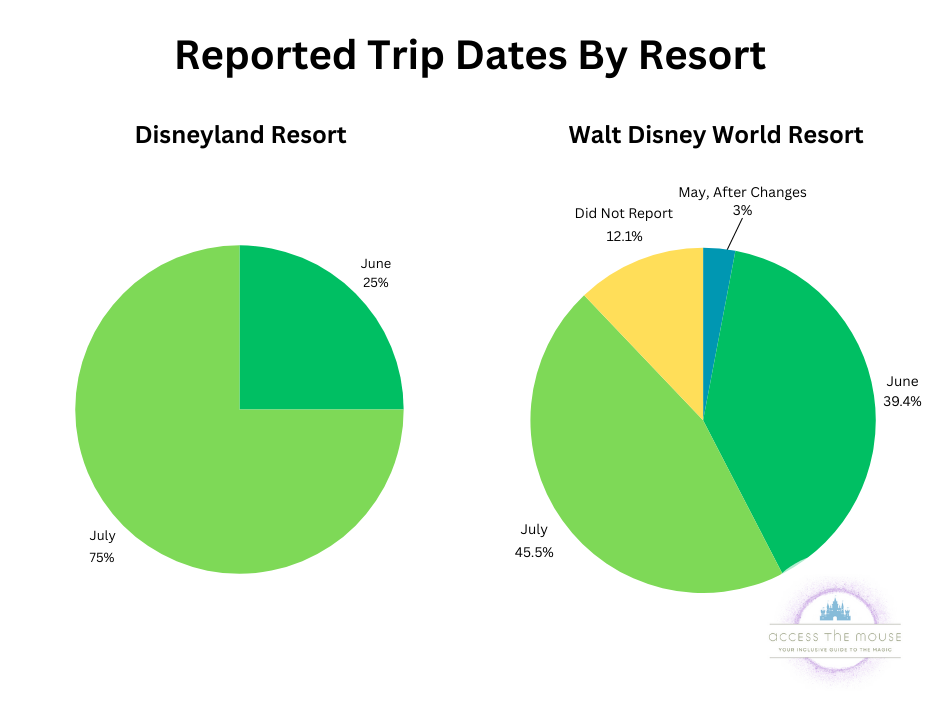
To better understand the make up of the survey responses it is important to note when the visits being discussed have occurred. 75% of the “West Coast” survey visits occurred in July, while 25% were in June. On the East Coast, 3% of respondents indicated that they visited the resort in May, after the changes occurred, 39.4% in June, and 45.5% in July.
DAS-Related Trends
One question on the surveys asks “Have you previously held a DAS pass or a Guest Assistance Card (GAC), and for how long?”
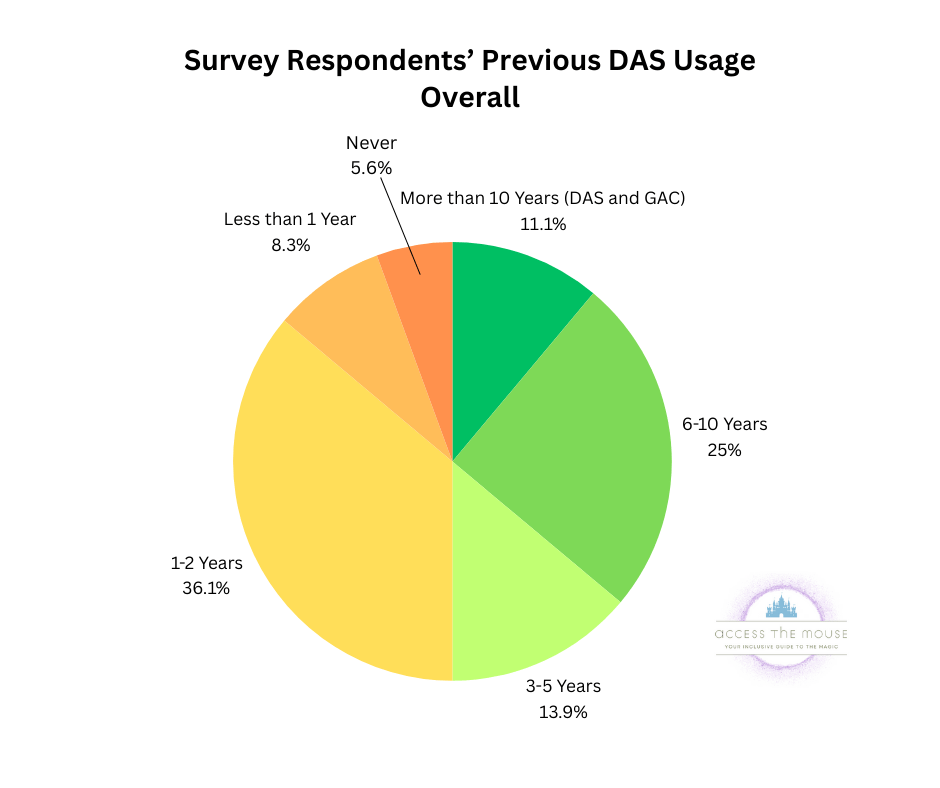
Between both resorts, an average of approximately 36% of survey respondents indicated that they have been DAS holders for 6 or more years, with approximately 11% having used both DAS and the previous GAC system. Users indicating that they have been DAS holders for 3-5 years average approximately 14% between resorts, and users indicating that they have been DAS holders for 2 years or less make up approximately 44% of respondents. 5.6% of survey respondents indicated that they have never been a DAS holder.
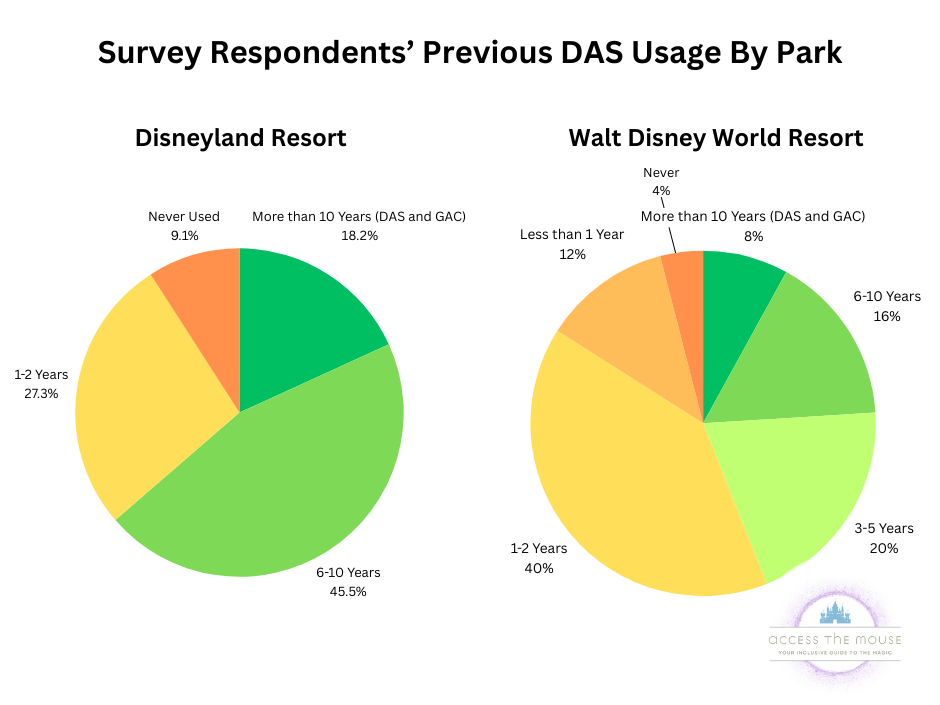
When you break this down by resort, 64% of Disneyland Resort respondents indicated that they have been DAS holders for 6 or more years, with approximately 18% having used disability services at the parks for more than 10 years. There were no “3-5 years” for this question on the West Coast survey. West Coast users indicating that they have been DAS holders for 2 years or less make up approximately 27% of respondents, and 9% indicated that they have never been a DAS holder.
At Walt Disney World Resort, only about 24% of respondents indicated that they have been DAS holders for 6 or more years, with approximately 8% having used disability services at the parks for more than 10 years. Users indicating that they have been DAS holders for 3-5 years average approximately 20% at Walt Disney World Resort, and users indicating that they have been DAS holders for 2 years or less make up approximately 52% of respondents. 4% of survey respondents indicated that they have never been a DAS holder.
(Personal Note: The breakdown between parks here is really intriguing to me. If this data is to be taken at “face value” nearly 2/3 of respondents on the West Coast have been using disability services for 6 or more years, while over 3/4 of respondents on the East Coast have either been using disability services for 5 years or less (or have never used disability services at all). I think this ties into what we’re seeing about the rise in usage, which Disney has described as “misuse,” but it also strongly correlates with COVID-19. I’d be interested to see a year-by-year breakdown on this data, if it were available.)
Recommended “Alternate Accommodations”
One question on the survey asks “If you did apply, what “alternate accommodations” were recommended to you by the DAS registration team after your denial?” and allows respondents to select from several options and to record their own responses.
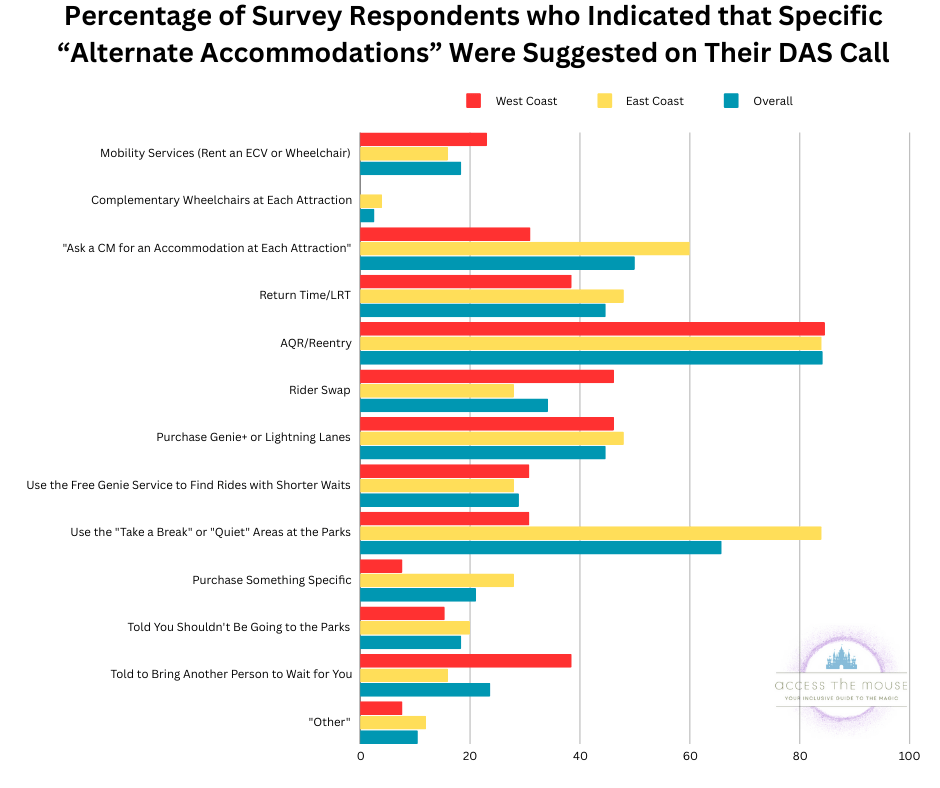
Most survey respondents who attempted to apply for DAS across parks indicated that they were recommended to utilize the “Attraction Queue Re-entry” program (84% overall, 85% West Coast, 84% East Coast).
Respondents indicated that most of the other “alternate accommodations” recommendations were very park-dependent. West Coast had no reported recommendations to utilize complementary wheelchairs at attractions, and had a higher recommendation rate for utilizing Rider Swap (46% West Coast, 28% East Coast), brining another person to wait in lines for you (39% West Coast, 16% East Coast), ECV or wheelchair rentals (23% West Coast, 16% East Coast), and using the free “Genie” service to find rides with shorter waits (more comparable at 31% West Coast, 28% East Coast). Purchasing Genie+ or Lightning Lane was also a common recommendation with 46% of respondents indicating this was recommended to them.
On the East Coast, most respondents indicated that they were told to use the “Take a Break” or “Quiet” areas at the parks (84%, tied with the Attraction Queue Re-Entry, compared to 31% on the West Coast.) There was also a significantly higher number of indications for “Ask a CM for an Accommodation at Each Attraction” (60% East Coast, 31% West Coast), and recommendations to “purchase something specific” that did not include Genie+ or Lightning Lanes. (28% East Coast, 8% West Coast)
Across Coasts, “Purchase Recommendations” from the DAS Team included
- 3 respondents indicating ear defenders, noise cancelling headphones, or ear plugs
- 2 respondents indicating fidget toys
- Others indicated fans, adult diapers, cooling towels, stress balls, and a mobility scooter
(Personal Note: I wonder about the lack of attractions wheelchair recommendations. Is this not available at the California parks? I was also surprised that reported recommendations to ask for a return time, specifically, was slightly higher on the East Coast, since the only U.S. Disney Park that technically “offers” Location Return Times is Disney California Adventure.)
Disability-Related Questions
Another question on the survey asks “What is the nature of your disability?” and allows respondents to select from several options and to record their own responses. This does not correspond with whether the user had applied for DAS, but does speak to what kinds of concerns respondents had, which would be reflected in the data.

The vast majority of survey respondents accessing the parks without DAS (80% overall) identified that they had an anxiety or trauma-related disability, including but not limited to Panic Disorder or Post Traumatic Stress Disorder.
The next-highest response overall was disabilities impacting the neurological, endocrine, and/or cardiac systems (48% Overall, 56% of West Coast, 43% of East Coast), followed by the “other” response.
One notable difference is that the East Coast respondents had a notably higher percentage for “gastrointestinal disorders” (47%) compared to the West Coast (19%), whereas West Coast had higher indications for “autism” (19% West Coast, 13% East Coast), “other developmental disorders” (31% West Coast, 20% East Coast) and “other psychiatric conditions” (13% West Coast, 10% East Coast).
Other reported disabilities include
- 5 respondents indicating “spinal issues” of some form
- 3 respondents indicating “immune system” related concerns, including autoimmune diseases and immunocompromised status
- 2 respondents each indicating migraine, Ehlers-Danlos Syndrome, Mast Cell Activation Syndrome, Postural Orthostatic Tachycardia Syndrome, and Cancer
- Various other responses, including but not limited to, adrenal issue, kidney disease, heat intolerance, crowd intolerance, pain, lupus, dysautonomia, Type I Diabetes, people on the transplant list, Deaf/HOH, low vision, TBI, and genetic disorders.
A follow-up questions asks “What aspects of your disability make long standby queueing unsafe or impossible?” and allows respondents to select from several options and to record their own responses. Again, this does not correspond with whether the user had applied for DAS, but does speak to what kinds of concerns respondents had, which would be reflected in the data.

For this question, the highest responses overall were “dissociation or panic attacks” (74% of respondents), “pain” (61%), “heat intolerance or severe sun sensitivity” (44%), and “incontinence or urgent need for a restroom” (41%).
Notably, East Coast had a dramatically higher number of respondents indicating a seizure disorder (20% East Coast, 6% West Coast), and “incontinence or urgent need for a restroom” (53% East Coast, 19% West Coast).
26% of survey respondents overall selected “other.” These responses include:
- 2 respondents indicating vomiting
- 1 respondent indicating “physical collapse while still conscious”
- other responses include, but are not limited to, confusion, edema, hearing loss, joint locations when stationary, and severe back spasms.
Comparisons of Rides and Time Spent Before and After DAS Changes
One section toward the end of the surveys asks users to compare the number of rides they were able to go on and the number of hours spent at the parks on an average day before the DAS changes to the visit they were discussing in the survey.
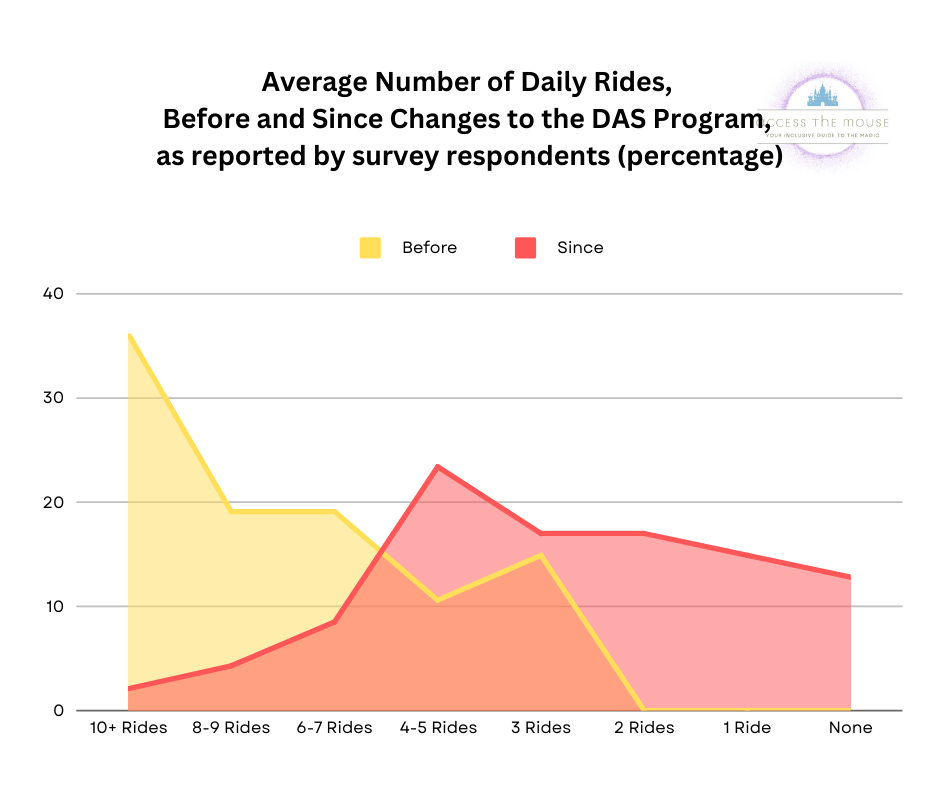
For the number of rides, 85% of respondents indicated that before the DAS changes, they were able to ride four or more rides in an average day, with 36% indicating ten or more rides. 15% indicated that the were able to ride an average of 3 rides in an average day before the changes took place, and no guests indicated riding an average of less than 3 rides in an average day.
Since the DAS changes, the number of respondents who indicated that they were able to ride four or more rides on this visit dropped to 38%, with just 2% indicating ten or more rides. 17% indicated that the were able to ride an average of 3 rides per day on their current visit, and 32% indicated that they were only able to ride 1-2 rides per day. Notably, 13% of respondents indicated “I wasn’t able to experience any rides I had hoped to.”
When it comes to time spent in the parks, similar trends are observed.
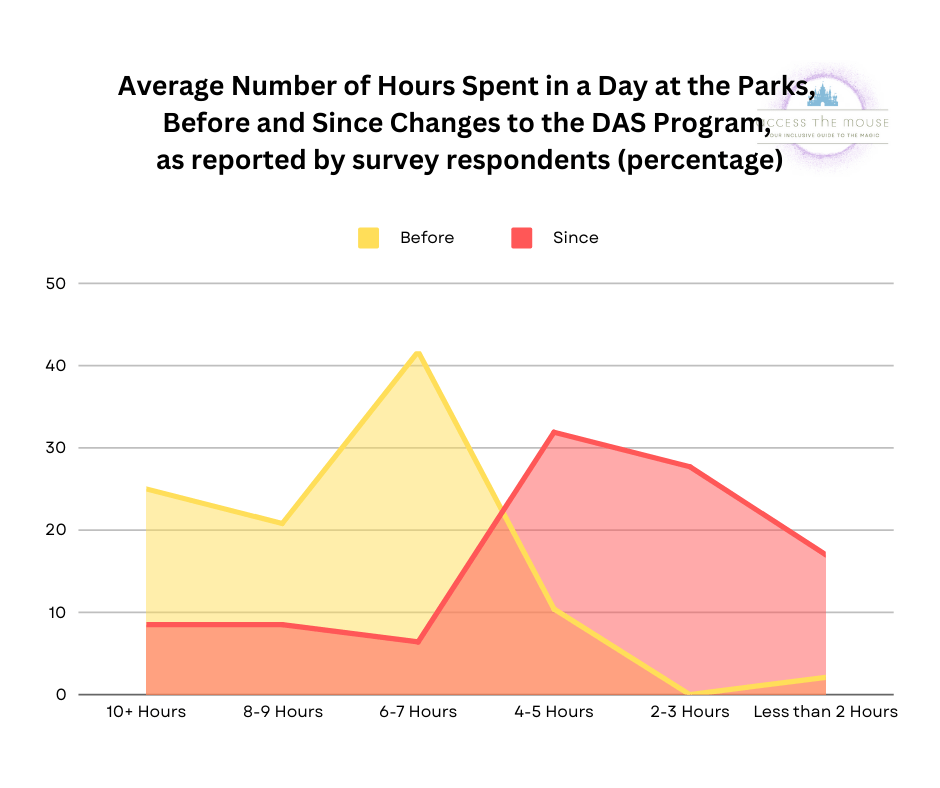
88% of respondents indicated that before the DAS changes, they were able to spend 6 or more hours in the parks, with the highest indication for 6-7 hours on an average day. Since the DAS program changed, the number of respondents who indicated that they were able to spend 6 or more hours in the parks dropped to 24%. 32% of respondents indicated that the averaged 4-5 hours a day on their most recent visit, while 45% only managed to spend 3 hours or less in the parks each day.
Other Reports
Disneyland Resort had no accessibility problems reported in the “West Coast” survey for any of the Disneyland Resort hotels, transportation, or special events. One issue was reported at the Downtown Disney District, where one guest indicated that the Lego store was “too crowded”.
At Walt Disney World Resort, no accessibility problems were reported in the “East Coast” survey for any of the Walt Disney World Resort hotels, Mini Golf locations, or Special Events. Other on-site issues include:
- Disney Springs: noise and heavy crowds, especially on weekends, inaccessible doors, and people blocking mobility devices after the drone shows
- Typhoon Lagoon: there are no accommodations at the Disney Water Parks, so guests were dealing with long lines, no return times, and one person indicated that the larger rafts are hard to carry.
- Transportation: 15% of survey-takers did not respond to the question about whether they faced issues on transportation. Another 36% indicated that they did not use resort transportation. Of those who did, 27% said there were no issues, and 21% indicated problems with crowded buses (one response indicated that the crowd was so heavy the user had to exit the bus), the monorail ramps being too steep, and issues with other people. One responded noted that they ran into major delays trying to get from Disney Springs to one of the deluxe resorts: “The first bus was “full” when I arrived so I was told to wait til the next bus… 15 minutes pass, bus 2 arrives, I get loaded. We’re waiting for the scheduled departure time when alarms go off on the bus. After 5 minutes the driver informs us they are sending another bus for us. That bus arrives, everyone exits and heads to the new bus. Before I’m unloaded, that bus left. So I have to wait for the next bus. It took me over an hour and 10 minutes to get back to the Poly.”
 Access the Mouse
3 thoughts on “Reflections on One Month of the RTQ Database”